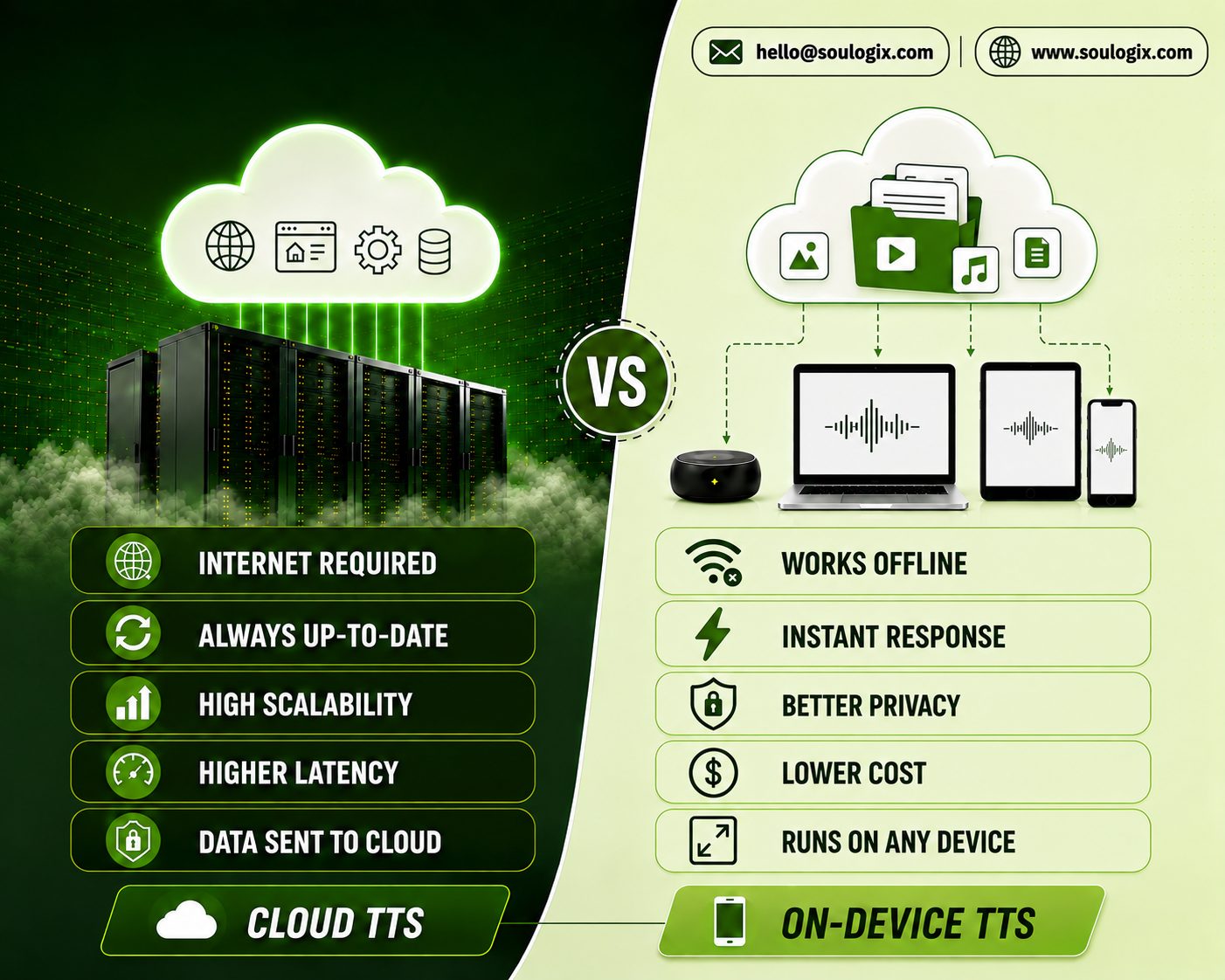
Cloud TTS vs On-Device TTS:
Cloud TTS vs On-Device TTS: Choosing the Right Text-to-Speech Solution for Your Business
Text-to-Speech (TTS) technology is transforming how businesses communicate, automate tasks, and deliver better user experiences. From virtual assistants and customer support systems to mobile applications and digital platforms, TTS converts written text into natural-sounding speech, making information more accessible and interactions more engaging.
When implementing a TTS solution, businesses generally have two options: Cloud Text-to-Speech and On-Device Text-to-Speech. Both offer valuable benefits, but the right choice depends on your business needs, performance expectations, privacy requirements, internet connectivity, scalability, and budget.
What Is Cloud Text-to-Speech?
Cloud TTS uses cloud-based services to process text and generate speech. The application sends text to a cloud service, which converts it into audio and returns the result to the user.
This approach provides access to advanced speech models, a wide range of voices, and centralized service management. Businesses can update their speech capabilities, integrate TTS into existing applications, and scale services as user demand grows.
Key benefits of Cloud TTS:
- High scalability: Handle growing user demands without relying entirely on local device resources.
- Advanced voice quality: Access sophisticated speech models and diverse voice options.
- Centralized management: Simplify updates, maintenance, and service improvements.
- Easy integration: Connect speech capabilities with websites, enterprise applications, and automated workflows.
Cloud TTS is particularly suitable for customer service platforms, enterprise applications, content delivery systems, and businesses that need consistent speech experiences across multiple users and locations.
However, Cloud TTS generally requires an active internet connection, and its use may involve network latency, service costs, and additional considerations for handling sensitive data.
What Is On-Device Text-to-Speech?
On-Device TTS generates speech directly on a supported device, such as a smartphone, computer, or embedded system. Instead of sending every request to a cloud service, the device uses a locally available speech engine to convert text into audio.
This approach can deliver quick responses, reduce dependence on internet connectivity, and help keep text processing local.
Key benefits of On-Device TTS:
- Fast response times: Generate speech locally without waiting for a cloud request.
- Improved privacy: Keep text processing on the device when the implementation supports fully local processing.
- Offline functionality: Continue generating speech without an active internet connection, provided the required voice engine and language data are installed.
- Reduced network dependency: Support reliable experiences in environments with limited or inconsistent connectivity.
On-Device TTS is ideal for mobile applications, accessibility features, offline tools, and applications where responsiveness and local data processing are important.
However, voice quality, available languages, and customization options can vary by device. Updates and compatibility may also require additional management across different platforms.
Cloud TTS vs On-Device TTS: What's the Difference?
| Feature | Cloud TTS | On-Device TTS |
|---|---|---|
| Internet connectivity | Generally required | Can work offline |
| Response time | Depends partly on network latency | Often faster for local processing |
| Privacy | Requires appropriate cloud data handling | Can keep text processing local |
| Scalability | Well suited to large-scale services | Depends on device capabilities |
| Maintenance | Centralized service updates | May require device-level management |
| Cost considerations | May include usage-based service fees | May reduce cloud usage costs but requires device resources |
| Best suited for | Enterprise platforms and large-scale applications | Mobile, offline, and privacy-focused applications |
Which Text-to-Speech Solution Should Your Business Choose?
The best choice depends on how your application operates and what your users expect.
Choose Cloud TTS when your business needs scalable speech generation, advanced voice capabilities, centralized management, and consistent services across multiple platforms.
Choose On-Device TTS when your priority is low-latency performance, offline availability, reduced network dependency, and local processing of sensitive text.
In some cases, a hybrid approach can offer the best of both worlds. Businesses can use Cloud TTS for advanced voice generation and large-scale workloads while relying on On-Device TTS for offline access or situations where immediate responses are essential.
Build Smarter Speech Experiences with Soulogix
At Soulogix, we help businesses explore practical technology solutions that align with their operational needs. By understanding your applications, workflows, and user expectations, we can help you identify the right approach to Text-to-Speech implementation.
Whether you need a cloud-powered speech solution, on-device capabilities, or a combination of both, the goal is to deliver communication that is efficient, accessible, and user-friendly.
Ready to make your business communication smarter with Text-to-Speech technology?
.